How Michael McDonald Lost His Voice

(This essay was originally published at Deadspin in 2014 and edited by Rob Harvilla. I’ve moved it here because that Deadspin is dead and I don’t want anyone to give them any traffic. I’ve lightly edited it as well, trying to replace as many of the dead links as possible.)
Image for article titled How Michael McDonald, The Affable Captain Of Yacht Rock, Lost His Voice
Illustration by Jim Cooke

Even 28 years after his last hit, Michael McDonald can still trigger laughter and tears. Though he’s still a fixture on the R&B/soft rock nostalgia circuit (catch him with Toto and Kenny Loggins this summer), that sui generis voice has been touring without him, so to speak, for decades. Recently, one ersatz McDonald popped up at an East Village karaoke bar, via the vocal cords of indie rock troubadour Mac DeMarco, who attempted “What a Fool Believes” as part of Wondering Sound feature:

DeMarco’s Michael McDonald impression, it will surprise no one to learn, is uproarious, a series of alarming grunts and man-rock noises that, six Stellas in, is simply the funniest thing any of us have ever heard. But then his voice hits falsetto on the chorus, and the bartender… is touched, muttering to his friend, “Every time I hear this song I just die.” Six Stellas in, I am convinced it is the most beautiful thing I’ve ever heard.

Even via karaoke, the Janus-style potency of the man’s voice and music is impossible to miss. The husky robo-soul of the “Fool” verse melody ascends on the chorus, and giggles turn to goosebumps. Then, when the falsetto hits on the “wise man has the power” part, it’s back to knowing chuckles.

Michael McDonald’s voice is so unique that for more than 30 years, it has subsumed Michael McDonald the man, much in the way that his beard subsumed 50 percent of his face during his peak years in the 1970s and ’80s. I have an impression of the dude in my own repertoire, and there’s a good chance many of you do, too. It’s not that hard. Doing a Ray Charles, an Al Green, or even a Daryl Hall requires a good deal of vocal training and genetic luck. A Michael McDonald impression, on the other hand, is 95 percent timbre—the subjective “color” of a voice—which I know because I have zero singing talent and can nonetheless imitate “I Keep Forgettin'” with a high degree of verisimilitude. I just find the spot in my throat where a sound that would otherwise signify “soul” instead sounds like one of those uncannily human Japanese robots programmed to “soul.” But at the same time, when I’m not mining it for laughs, there’s something about “Fool”—an emotionally potent song, once you strip away everything you’ve learned to remember about the late 1970s—that can move me in a very different way.

McDonald, the winner of five Grammys and the seller of tens of millions of records, has had a significant career that continues to this day, through which he has honestly moved millions of listeners without a trace of irony. His popular reputation over the past three decades, however, primarily involves joke fodder. Darryl Hall is a white guy with a Motown-derived soul voice as well, but you don’t see a Conan O’Brien desk bit devoted to how intrinsically hilarious it is to see Daryl Hall sing “Maneater” to a bunch of kids at summer camp. Boz Scaggs isn’t the butt of Paul Rudd’s arson-and-murder joke in The 40-Year-Old Virgin, and Kenny Loggins isn’t getting that South Park money. You don’t see Jimmy Fallon—the Ed Sullivan of LOL-mining—invite Justin Timberlake to sing “Row, Row, Row Your Boat” in rounds with Phil Collins.

Whereas Mike has received all those honors, and many more. It was the fake origin myth of “What a Fool Believes” that birthed “Yacht Rock”—the web series and the loath portmanteau—for Christ’s sake. As a blue-eyed soul singer who evokes a period when white guys could gaudily evoke an African-American idiom, McDonald has had a much more interesting post-fame career than Barry Gibb (despite Fallon’s and Timberlake’s best efforts) or Michael Bolton (patron saint of the Lonely Island), and thankfully hasn’t, like poor Rick Astley, had a hit single become the butt of a webjoke. He makes us laugh, sure, but he doesn’t just make us laugh. How did all this happen?

Two video clips, released three decades apart, demonstrate how McDonald has been portrayed less as a singer and more as a vocal technology—what audio engineers call a punch-in. Back when he was still a bonafide star, SCTV—the Canadian SNL—parodied McDonald’s knack for knockout backup vocals. In a sketch, Rick Moranis’s proto-VJ character Gerry Todd cuts to what is announced as a video clip for Christopher Cross’s 1980 No. 2 single “Ride Like the Wind.” What we get is very different: a brief vignette of McDonald speeding his way to the studio as Cross’s verse plays, then running into the recording booth just in time to record his vocal, which famously hits on the chorus. The bit is repeated a few times. Then he bounces back into his car, presumably to speed off to the Mexican border.

Thirty years later: same song, very nearly the same joke, as Cross himself performs “Ride Like the Wind” on Late Night With Jimmy Fallon in 2009, though the clip has vanished from YouTube. (The Roots are wearing yacht-captain hats, a product of the seas of cheese that Cross’s music had sailed in the decades since his eponymous debut album swept the Grammys on the way to selling five million copies.) For Fallon, it wasn’t enough to simply stage Cross performing the song; apparently unbeknownst to Cross (judging by his bemused but unflappably professional expression), and right on cue before his background vocals were set to appear, here comes Michael McDonald in the flesh, upstaging Cross by taking his seat at the keyboard, right in time to belt out his line. Such a long way to go, for more or less the exact same reason. I still get goosebumps when McDonald comes onstage.

One of his most singular accomplishments is that he’s perhaps as well known for his backing vocals as his songwriting and lead singing. The world at large first encountered The Voice untethered from The Man in much the same way that Fallon and Moranis used him: as a ghostly apparition answering a lead vocal, this time on a Steely Dan album. During their 1970s run, guesting on a Steely Dan cut could be a career-making opportunity for L.A. session guys. McDonald—who moved to L.A. from St. Louis in 1970 to cut some demos that RCA would shelve—happened to fit perfectly with Walter Becker and Donald Fagen’s session-musician song factory named after American literature’s most renowned dildo. I imagine the first meeting McDonald had with Becker and Fagen happened in the manner of Jack Horner encountering Eddie Adams in Boogie Nights: They caught his voice at some chintzy Hollywood supper club, and convinced him over drinks that his unique gift could make him a star.

Maybe not. Regardless, Steely Dan’s 1975 LP Katy Lied was McDonald’s first gig, and he made the most of it. The first song they put him on was “Bad Sneakers,” a druggy fever dream written by two jaded New Yorkers shielding themselves from the L.A. sun. The first chorus featured Fagen, a peerless popsmith whose own Dylan-jazz vocal style is itself fairly odd. McDonald first emerges on the song’s second chorus, echoing the phrases “goin’ insane,” “laughin’ at the frozen rain,” and “so alone” like he’d swallowed whole and was belching out an entire gospel choir. I don’t know if it was “Bad Sneakers” that caused Frank Zappa to dub Steely Dan “downer surrealism,” but the mixture of junky imagery, 50-take jazz charts, and McDonald’s uncanny-valley Solomon Burke still makes for an appealing pop nightmare.

“Sneakers” was the moment that McDonald changed from an anonymous white R&B drifter to one of pop’s most unique vocalists. “I noticed I had something different when I sang ‘Bad Sneakers’ for that record,” he later remembered. “It was the first time I’d heard myself alone in a background capacity. Somehow my voice took on a sort of ethereal sound because of the timbre of it. Fagen liked the sound a lot.”

It makes a lot of sense that Fagen—who, perhaps mythically, instructs his female backup singers to “sing white” as a distancing device from soul signifiers—would love McDonald’s unearthly timbre. The question arises: What in the world is that timbre? Do some searching and you’ll find McDonald equally described as a baritone and tenor, by people who are equally informed enough to credibly make such claims. The secret lies in how he tweaks the register of his natural voice, adding unique color to it. I asked my friend Christian Gentry, a musicologist and composer, to listen to a few tracks and describe what he heard. “What makes his voice so unique is that he resists the urge to actually sing in his baritone range,” Gentry replied.

If you listen to him speak naturally (in interviews), he is clearly a baritone, and his tessitura (or natural range) should be a lot lower than what he sings. His vocal cords produce a more resonant sound when he speaks. This is clear where you hear no vocal fry, which is an acoustic phenomenon of trying to physiologically force your vocal chords to resonate at a lower pitch level than is natural. McDonald forces his range upward in most of his songs, and it requires more breath to go through the vocal cords to get them to resonate, hence the McDonald tone: an urgent earnestness that glosses over the breathiness and strained nature of the sound by falling off of pitches and quick vibrato. McDonald’s voice is a breath of fresh air as a non-operatic tenor and unnatural baritone.

What would become the urgent earnestness of McDonald’s timbre was forged as a young singer in St. Louis R&B groups who had his eye on a long career. “I grew up in the era where everybody wanted to sing like Mitch Ryder and James Brown,” he told an interviewer in 2013. “And I did, too. But I learned real quick that it hurts after awhile. Along with trying to find ways to sound like the guy on the record, we all tried to find ways to be able to sing five sets a night without losing it halfway through the evening.” A self-preservation style of singing, in other words, allowed his timbre to float freely across several decades, opening up any number of reappropriation possibilities.

With Steely Dan, McDonald popped up on a couple other Katy choruses—the sour nostalgia of “Any World (That I’m Welcome To),” the gleaming romance of “Rose Darling”—but if he’d left the business entirely after his guest-work on the band’s classic 1977 album Aja, he’d still have retired a legend. Fagen isolating McDonald’s background vocals on “Peg” in this documentary clip is fairly revelatory of McDonald’s gift. As McDonald himself explains (you can compare his speaking and singing voices here), he was tasked with singing certain words on the chorus, with exacting, bizarre nuances that created an alien effect.

In his book on AjaDon Breithaupt referred to McDonald as “a foil for Fagen’s dour leads” and “the dominant color” in the song’s vocal-backup stack. Listening to “Peg,” it’s subtly miraculous that even a voice like McDonald’s is able to rise above the carefully orchestrated din in a hit song with dozens of individual parts, a hook every three seconds, a solo played by Tom Scott on a fucking lyricon, and a Byzantine melodic structure that, like Zappa’s “Peaches en Regalia,” is catchy as hell in spite of its grad-school opinion of itself. And “Peg” wasn’t even McDonald’s finest moment on Aja: That would be his scenery-chewing on the Broadway-disco newspaper-heiress tryst-fable “I Got the News,” which shoves McDonald out front for a dramatic flourish on what amounts to the song’s middle-eight section.

Aja was a massive hit for Steely Dan, but by 1977, McDonald was already in the process of single-handedly transforming another million-selling band in his own image. On the back of the surprise FM hit and million-selling single “Black Water,” the Doobie Brothers, a Northern California boogie-rock group who started by playing gigs for the Hell’s Angels, had turned into one of the country’s most bankable touring bands. When lead singer Tom Johnston fell ill from too much partying in 1975, however, guitarist Jeff “Skunk” Baxter—who’d left Steely Dan a couple years earlier after playing the fucking insane solo on “My Old School”—recommended McDonald come aboard, at least for a tour. He’d end up sticking around for several years, and the band’s next album, 1976’s Takin’ It to the Streets, started one of rock history’s most significant, and successful, sound overhauls.

Over the years, the 1976-1980 Michael McDonald Doobies have been pitted against the 1971-1975 Johnston Doobies in one of the most fairly matched Bands With Two Different Lead Singers battles ever. They enter countless pub debates alongside Van Halen vs. Van Hagar, “Tempted” Squeeze vs. “Pulling Mussels from the Shell” Squeeze, Collins Genesis vs. Gabriel Genesis, and Ronnie James Dio Sabbath vs. Ozzy Sabbath (just kidding). I’m very fond of Doobies Mk. 1, but then again, Tom Johnston didn’t write “What a Fool Believes.”

McDonald’s voice couldn’t have been different than Johnston’s: a chocolate fountain vs. tanned leather. He represented an emergent musical language—the soft, R&B-influenced, synthesizer-friendly pop of Cross, Hall & Oates, and the Quiet Storm radio format—while Johnston stood for the kind of longhaired grooviness that was quickly turning residual, and probably shouldn’t have lasted as long as it did. Compare two similarly titled songs to understand how the Doobies’ brand finessed the changeover: the platonic choogle, harmonica solo, and Eagles-style harmonies of early Doobies gem “Long Train Runnin'” versus the languid gospel-funk of “It Keeps You Runnin’,” which had much more in common with Rufus and Stevie Wonder than anything Johnston was listening to.

The Doobie Brothers were, um, named the Doobie Brothers, but it’s still remarkable how totally fucking stoned McDonald could make them sound. Listen to how he slurs his words into a paste on “Minute by Minute,” how the groove just slinks in under the door in the “Oh, are we recording now?” kind of in medias res yellow-smoke haze reminiscent of Sly Stone’s “If You Want Me to Stay.” The rest of Minute by Minute is fairly terrible, but the title track, “Runnin'”, and especially “Fool” were sui generis new wave robo-soul, and McDonald was suddenly a leading man.

Post-Doobies, he didn’t cut the kind of pop-star figure necessitated by the MTV era—guys who look like Bob Vila don’t get teens going crazy when there’s Prince to freak out over—but between the singles “Sweet Freedom” and “I Keep Forgettin’,” not to mention his collaborations with Cross, James Ingram, the Kenny Loggins (with whom he co-wrote the miraculous “This Is It”), and the Patti LaBelle collaboration “On My Own,” McDonald more than stayed afloat while a new youth culture took shape. Though at the same time, it was obvious that he wasn’t long for a music landscape driven by visuals—just check his body language at the end of the “Sweet Freedom” video. After three and a half minutes of Billy Crystal and Gregory Hines hamming it up in Hawaiian shirts and Walter Payton jerseys, they pull McDonald in, and though he’s game to play along, his awkwardness at lip-syncing and play-acting signals he’s more comfortable anywhere else. Fate had different plans for him, and for us.

A side effect of an iconic voice is the way you’re forced to cede it to the pop-cultural meat-grinder, which means watching something you spent countless hours perfecting being subjected to hammy impersonations. “I have more people walk up to me and do their Michael McDonald,” he confessed last year. “While I’m trying to get a yogurt or something in the airport, some guy realizes it’s me and starts singing his favorite Michael McDonald song. And I’m flattered, you know; don’t get me wrong. But it hits me once in a while that I’m like one of the world’s caricatures.”

This may sound sad, but the guy’s got a good sense of humor about it. “This one’s for Paul Rudd!” he exclaimed before performing “Ain’t No Mountain High Enough” for a Florida casino audience in 2006. Much in the same way that Christopher Walken, Robert DeNiro, and William Shatner gamely toy with their iconic earnestness from earlier eras, McDonald’s not above giggling at where his voice has gone from an ironic remove.

Still, however, his legacy is not solely lulz. There are modern musicians who proudly echo his penchant for earnestness. In 2009, McDonald saw Grizzly Bear perform in New York City—he and a member of the band share a mutual industry contact—and was wowed by the Dan-like intricacy of their arrangements. “When I was with the Doobies … we all went over the falls with chord progressions, trying to make things as complex and interconnected as possible,” he told Paste. “I never thought that would come back around, but it has.” Flattered, the band gave McDonald their song “While You Wait for the Others” to play with, and he nailed it.

In an email, Grizzly Bear co-leader Daniel Rossen, the vocalist on the original version of “Others,” explained the choice, which baffled more than a few listeners who assumed the choice was pure irony. “He’s a really genuine and unpretentious performer, and his voice has a really warm and lovable timbre that is instantly recognizable,” Rossen explained. “To me, Michael McDonald is a rare sort of singer that can be virtuosic while still carrying a lot of joy and heart through his performance. It was such a surreal experience to hear Michael McDonald sing our song that we couldn’t pass it up.”

It also helps that Grizzly Bear, like McDonald, are profoundly earnest. Two years later, a friend of DFA-signed New York synth-pop duo Holy Ghost—a deceptively earnest band who wrote one of the few songs of the past decade that can still make me cry—discovered that they, too, had an industry link to McDonald. On a lark, they sent him their song “Some Children”; he loved it, added vocals, and voila, McDonald’s punched-in timbre was triggering fresh goosebumps in 2011. Though many self-respecting 21st-century indie fans couldn’t bring themselves aboard McDonald’s brand of overpowering earnestness, it’s a testament to his own potency that he’s able to merge so seamlessly and unironically into a moment that most would assume wants nothing to do with him. Hot Chip, you’re on the clock.

I can’t claim to be able to explain what it is that happens when Michael McDonald’s voice—or ersatz representations of it—leaves his lungs, is recorded and transduced, travels through air to reach my ears, brain, and heart. The French philosopher Roland Barthes, mesmerized by the same phenomenon in a very different context, coined the phrase “the grain of the voice” to find a pathway into vocal description that eschewed critics’ tendency toward adjectives. “The materiality of the body speaking its mother tongue,” Barthes wrote as a way to get at the uniqueness of the singing voice. My musicologist friend Christian describes the effect somewhat differently for McDonald: “The magic really happens when he floats into his falsetto voice. His ‘break’—moving from the natural chest voice to head voice—is around B-flat4 (ca.466 Hz).”

However it’s described—via hertz or hurts—the effect of the man’s voice is singular. For decades, it’s been simultaneously capable of triggering knowing laughter and countless pretty-good impressions at the exact same time that it (for me and millions of others) slips past my defenses and hit me right in the gut. If the singer himself is OK with this split personality, so am I. Michael McDonald has long lost his voice, and we’re all richer for it.
The Best of CTI Records

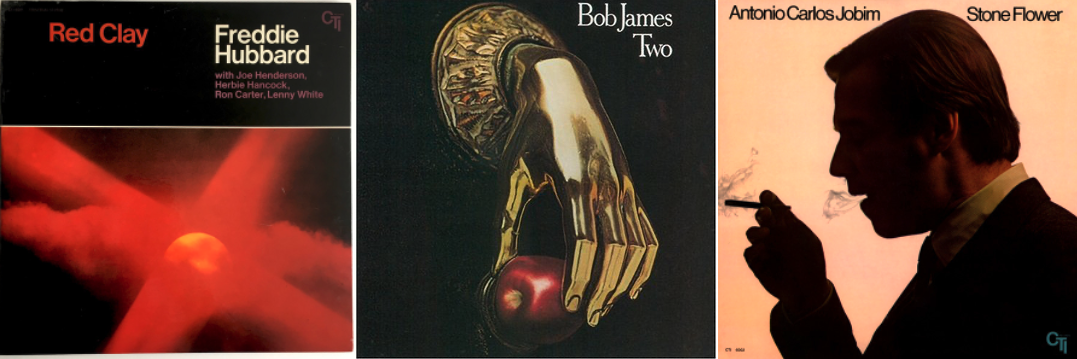
When Creed Taylor died last week at 93, the first thing that came to my mind–and perhaps many others’ minds–were his initials, stylized with an “I” for “International” positioned somewhere in the corner of a few dozen pop-leaning jazz albums from the 1970s. After some work with ABC Paramount, he founded Impulse! and quickly left to take over Verve (not a bad CV), before launching CTI under the aegis of the middlebrow pop juggernaut A&M in 1967, bringing with him the ear that gifted bossa nova to the world and quickly assembling a roster of session players and arrangers who would take jazz fusion to the suburbs. Taylor brought photographer Pete Turner to CTI from Impulse! (where Taylor developed the orange/black color scheme and insisted on heavy cardboard packaging to convey importance–not that John Coltrane needed much help there), who, coupled with designer Sam Antupit, established those CTI initials as a dependable brand of 1970s jazz.

Not everyone‘s brand, of course! Plenty of jazz fans dismiss CTI as watered down dinner-party fusion, but during my hip-hop sample-pilled early crate-digging days in the mid-1990s, bins were clogged with near-mint CTI LPs that had been dumped en masse by collectors upgrading to CD or just clearing space. A quarter-century before that, when Red Clay and Bob James Two were new, a generation of middle-class African-Americans had scooped them up too–and then their kids started isolating and looping the clean rhythmic breaks that so many of them contained (even more were found on the red-black-and-green-branded CTI subsidiary Kudu), laying the foundation for hip-hop.

Taylor’s stable of session men and leaders was deep: Hubbard, bassist Ron Carter, drummers Airto Moreira and Steve Gadd, pianist/arranger Eumir Deodato, saxophonist Stanley Turrentine, reedist extraordinare Joe Farrell, vibraphonist Milt Jackson, guitarists Wes Montgomery, Jim Hall and George Benson, flutist Hubert Laws, and others. Others made their names elsewhere but cut memorable tracks or albums for CTI: Antônio Carlos Jobim, Paul Desmond, Quincy Jones, Herbie Hancock, Jack DeJohnette, Milton Nascimento, Nina Simone, Chet Baker.

There were bonafide hits, too–the first Deodato LP spawned “Also Sprach Zarathustra,” which peaked at #2 on the Hot 100, won the 1973 Grammy for Best Pop Instrumental Performance, and had Billboard calling CTI the best jazz label. Suddenly Taylor had his version of ECM’s The Koln Concert–an out-of-nowhere hit that forced him to recalibrate his entire business model. Taylor sunk millions into an independent distribution operation to keep up with demand, but when subsequent Deodato, Benson and Turrentine LPs didn’t rise to the occasion, CTI took a massive economic hit from which the label never recovered. Warner came sniffing around and pinched Benson for his massive Breezin’ LP; Taylor turned to Columbia for distribution in 1976 but the writing was on the wall. CTI would fold by the end of the decade.

Below is a list of CTI LPs that I think any respectable music collector should have in their collection–you can build a solid stack for about $100 on Discogs, I bet–and a 50-track playlist that covers Taylor’s impressive run (I’ll do a Kudu one next). Don’t forget the under-heralded stuff and deep cuts though: all of Joe Farrell’s CTI albums are worth it, as are the late 70s disco/funk excursions like Art Farmer’s Crawl Space, Urbie Green’s Manteca and Yusuf Lateef’s In A Temple Garden. The arranger David Matthews released the huge and weird Dune in 1977, which is notable only for the guitar sample from the break in the middle of the “Space Oddity” cover, but very notable at that. And one of the early and very non-representative CTI releases is one of the label’s best: Oklahoma Toad by pianist and songwriter Dave Frishberg, perhaps best known for writing the Schoolhouse Rock standard “I’m Just A Bill.” Toad, however, is nothing like that–more than anything it sounds like weird outsider pop, the kind of thing that you’d expect to hear today on Captured Tracks or something.

Fifteen Must-Own CTI LPs:

  1. Paul Desmond – From the Hot Afternoon (1969)
  2. Antônio Carlos Jobim – Stone Flower (1970)
  3. Dave Frishberg – Oklahoma Toad (1970)
  4. Freddie Hubbard – Red Clay (1970)
  5. Astrud Gilberto & Stanley Turrentine – Gilberto With Turrentine (1971)
  6. Stanley Turrentine – Salt Song (1971)
  7. Airto – Free (1972)
  8. Deodato – Deodato (1972)
  9. Joe Farrell – Moon Germs (1973)
  10. Milt Jackson – Sunflower (1973)
  11. Ron Carter – Blues Farm (1973)
  12. George Benson – Bad Benson (1974)
  13. Bob James – Two (1975)
  14. Jim Hall – Concierto (1975)
  15. Nina Simone – Baltimore (1978)

Fifty CTI tracks:

From the Window, Rang Two Shots

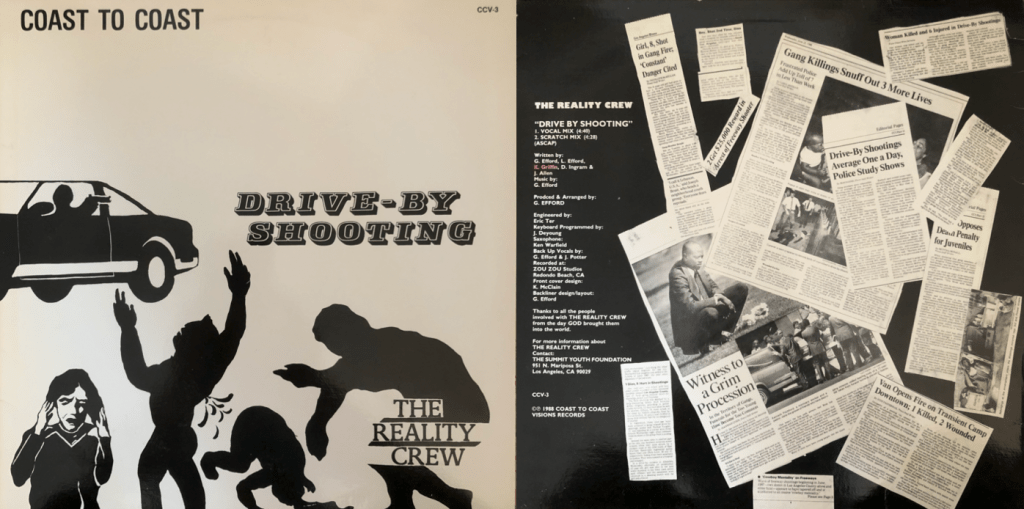
The Reality Crew “Drive-By Shooting” (Coast to Coast Visions, 1988)

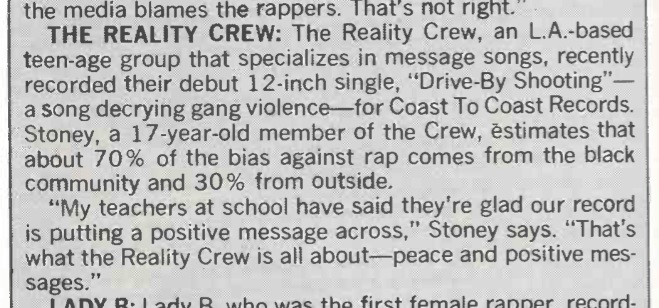
I found this song about a year ago during book research, via a short mention in a 1988 Billboard article on rap’s growing importance to the record industry. Titled “Artists on Image: Pinpointing Resistance to Youth New Wave,” the piece asked Ice-T, J.J. Fadd, The Reality Crew and a few others a surprisingly cogent question: where is the backlash to rap coming from?

Predictably, Ice-T was the most outspoken respondent. In late 1988, he had already released two albums on Sire, and positioned himself as the spokesman for the fledgling L.A. rap scene. Though his music sounded little like Public Enemy’s, T shared Chuck D’s view of the political economy of backlash. “I don’t think the negative propaganda about rap comes from the true black community–it comes from the bourgeois black community, which I hate…The bourgeois blacks term Freddie Jackson ‘good R&B’ and rap as ‘n***er music, too black.'” It’s easy to see in T’s quote the emergent battle over “keeping it real” that would start roiling hip-hop over the next couple years.

As far as I can tell, a subsequent quote in the article amounts to the only public mention of The Reality Crew in existence. “Stoney” offers a very different rationale for rap’s backlash, and stresses the positive–if not educational–uses of the music and culture:

I immediately went to Discogs and bought a copy of the record from a San Diego-based dealer for $14.39 + shipping. (NB: when I found the song on YouTube a couple months ago, I saw that it had been uploaded for the first time, by a completely different person, a week after I bought the 12″, which weirded me out.) The album jacket provided scant information about the individual rappers on “Drive-By Shooting,” but my ear told me they were all teenagers. An organization called “Summit Youth Foundation” is mentioned, but there’s little information online, and to me it merely suggested that the record was likely not released for the typical music industry reasons–to make money and establish stars–but as the public-facing product of a social program.

I dug a bit deeper, which was challenging because only one person is credited on the sleeve by their full name. But a bit of searching revealed that “G. Efford,” the song’s producer and arranger, is more than likely Gary Efford, who had carved a small musical space for himself in the world’s most crowded entertainment market. He performed a set at the September 1984 Los Angeles Street Scene Festival, wedged between the Los Angeles City Youth Band and the L.A. Rams Cheerleaders. The event’s headliners were Etta James and the kids from “Fame,” but the most popular attraction appeared to have been the “Break-Dance Park,” where local crews popped and locked to electro-funk music provided by some of the city’s mobile DJ crews. Two years later, Efford released two singles in the new wave-infused R&B mode of Prince and Rick James on a label called California Visions Records. I’m partial to the song called “Sexy.”

The only person with a full credit on “Drive-By Shooting” is saxophonist Ken Warfield, whose work can be heard under the chorus, and who gets a short solo about three and-a-half minutes into the song. Warfield grew up in south Los Angeles and took up music at an early age. Though he scored some high-profile gigs, and even toured Europe at one point, Warfield–like the vast majority of musicians–found steady, paying work hard to come by, and started playing in public, for tips. He settled on a spot in the pedestrian tunnel that exits the Hollywood Bowl and dips underneath Highland Avenue, because of the acoustics. As explained in this 1991 Los Angeles Times article, Warfield earned the name “The Sax Man” for playing everything from jazz standards to “Happy Birthday,” “Für Elise,” and the “Flintstones” theme to passersby leaving concerts played by much more well-known and well-compensated musicians a few hundred yards away. Warfield was still playing there as of 2016.

“Drive-By Shooting” is one of hundreds, if not thousands of one-off recordings cut in a non-descript studio by non-famous musicians and released in a limited number, in 1988 alone. But even if the record was not historically significant enough to wind up in my book, the name “Reality Crew,” coupled with the single’s back-sleeve design, resonated with me. The sleeve artwork is a crude montage of L.A. Times clippings about several deadly drive-by shootings from summer 1988: June 21, June 22, July 14. The lyrics, which I’ve transcribed here, tell similar stories of suburban scenarios–a grandmother planting her garden, a kid shooting hoops, people sitting at a bus stop–interrupted by semi-automatic gunfire suddenly erupting out of a passing car. “Drive-By Shooting” is a simple song completely lost to history, but even as pop folklore, it’s a clear heir to hip-hop’s early-80s journalistic pivot on hits like “The Message” and “It’s Like That.” Its verses alternate between first-person testimonials and opinion, and the chorus is sung in the declarative present tense of breaking news (“There’s a drive-by shooting going down right now”), echoing the tabloid headline approach pioneered by Melle Mel’s “broken glass, everywhere!” and DMC with “unemployment’s at a record high!” (Weirdly, a conservative message pops up midway through the song that sounds like it was shoehorned in from a Reagan-voting adult supervisor: “If you want some advice / And a chilled solution / Just bring down the age of prosecution.” I’m not entirely sure what to do with that.) Between their name, their lyrics and the news clippings, it was clear that The Reality Crew wanted their music to be understood as a journalistic kind of truth.

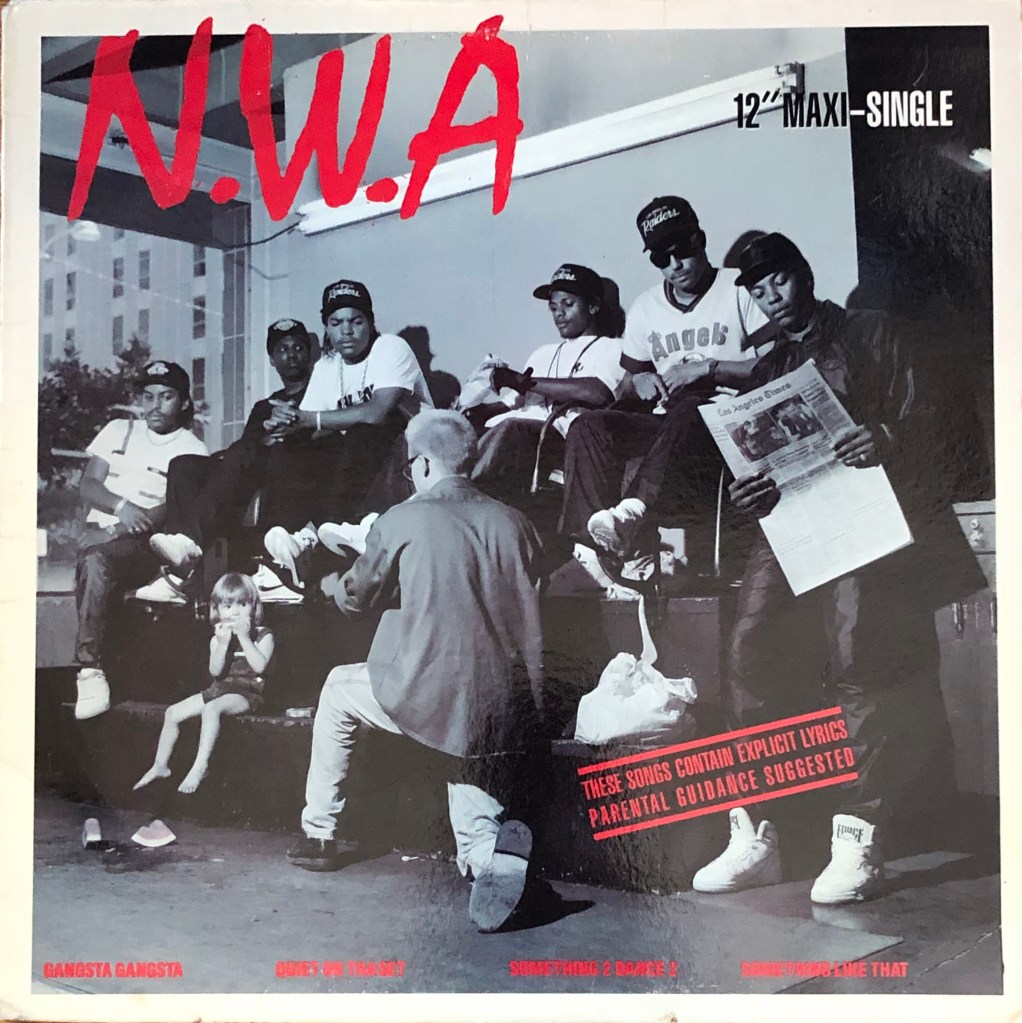
On the cover of the 12″ single for N.W.A.’s 1988 single “Gangsta Gangsta,” Dr. Dre is reading the July 30, 1988 issue of the Los Angeles Times. Though the issue is just a couple weeks after the clippings from The Reality Crew’s montage, it was immediately clear that N.W.A. were approaching news culture and “reality” from a dramatically different perspective. The track opens with a dramatization of a drive-by shooting conducted with mischievous glee on an unsuspecting civilian by an Eazy-E-voiced character. Dre scratches KRS-One’s lyric “It’s not about a salary / It’s all about reality” into the “Gangsta” chorus, but though lyricist Ice Cube was a fan of Boogie Down Productions, the song doesn’t pit commercial interests against truth, but positions the former coming as a result of the latter, which to N.W.A. was a brutal, hyper-parodic reality of black lives in Compton and South Central–the exact scenario that “Drive-By Shooting” was created to decry.

The “reality” in The Reality Crew’s imagination was a straightforward indication of the music’s truth value–essentially commensurate with the field of journalism. The “reality” of N.W.A.’s music and identity, however, was cut from the postmodern, hyperreal mold of reality television, pioneered by a new crop of television producers and stars who were rapidly moving the goalposts for what counted as TV news and documentary programming. Kevin Glynn calls it “tabloid culture,” a space where journalism and entertainment intersected to create a new form of lurid, populist programming that bent the tropes of television news and documentary in shocking and entertaining ways. Glynn groups the genre into three types:the Reaganist law-and-order propaganda of Cops and America’s Most Wanted; boisterous daytime talk shows like Donahue, Oprah, and Geraldo; and prime-time lurid sensationalism in the form of A Current Affair, Hard Copy, and Inside Edition.

They’ve never been understood in the same context, but N.W.A., (and Ice-T and Chuck D, and later 2Pac) imagined their public roles in the same technologically sophisticated, genre-hybridizing, populist mold as their tabloid TV counterparts, and freely borrowed journalistic tropes to do so. Look at Ice-T at the start of the video for “High Rollers” or listen to Dre and Cube open “Express Yourself” by claiming that other rappers were “scared to kick reality,” in a song that advocates for the effective use of subjects and predicates. Even to the apolitical Eazy-E, N.W.A.’s music was “the real story of what it’s like living in places like Compton. We’re giving them reality. We’re like reporters.” Realism may have been a rhetorical feint to win an argument, but so are all claims to objectivity under capitalism. After all, journalism has always existed in an uneasy relationship to–and reliance upon–public relations, celebrity culture, and spectacle. The “high modernist” journalistic mainstream sought to keep these forces at arm’s length, but reality/tabloid culture welcomed it. Beyond his entrepreneurial innovations, perhaps Eazy-E’s most lasting contribution to hip-hop is his fixation on achieving what Leo Braudy dubbed “the frenzy of renown,” an urge to fame by any means necessary. More than any of his peers, Eazy obsessed over his own press: he’s often photographed reading his own coverage or holding up a magazine with an N.W.A. feature front-and-center.

By definition, drive-by shootings are impossible to predict, let alone defend. In military jargon, they’re not a staged battle, but closer to a foray, or raid. In a city or suburban environment, they’re a form of urban guerrilla warfare, creating a low-level fear that any slow-moving vehicle could be a deadly enemy. Because of the heightened possibility for innocent bystanders to catch stray fire, they’re closer to a terroristic tactic, designed to inspire fear in a population, than a guaranteed method to eliminate a specific rival. Drive-bys had been chronicled by gang researchers since the early 1960s, but they accelerated with the explosion of gang warfare in the crack-and-gun-glutted 1980s. Though they were commonly reported in the Times throughout the decade, the L.A.P.D. didn’t collect data on drive-bys until 1989. Over the next five years, 6,327 such incidents were reported to the authorities, and a 1994 New England Journal of Medicine study characterized them as “an important cause of early morbidity and mortality among children and adolescents” in Los Angeles. To journalists, all of this information added up to the most newsworthy outcome of L.A.’s gang problem. They quickly became national news along with the Bloods and Crips, and spread nationwide.

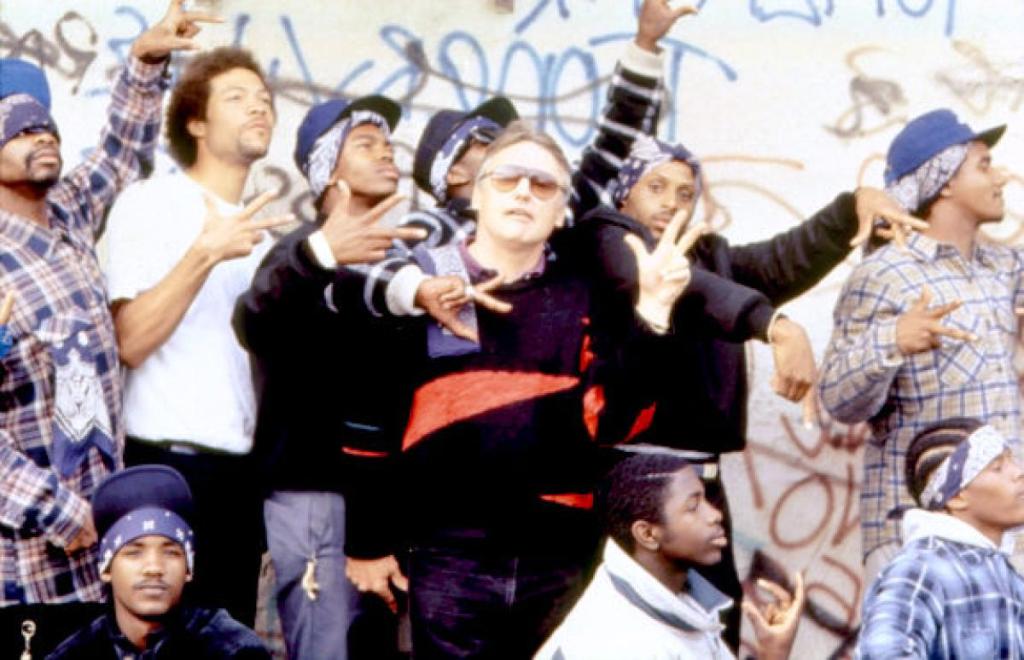
Dennis Hopper, throwing up a set on the set of “Colors”

On April 8 and 9, 1988, Daryl Gates’ anti-gang C.R.A.S.H. unit conducted its biggest gang sweep yet. The L.A. Times headline covered the operation from the cops’ perspective: “Police Call Gang Sweep A Success; 1,453 Are Arrested.” The operation sweep was less driven by actual strategy–most of the arrestees were released without charges–than as a P.R. move in the wake of the January killing of a non-Black person (Karen Toshima) in a non-Black neighborhood (the entertainment and shopping district Westwood). One week after Gates’ sweeps, on April 15, Orion Pictures released Colors, directed by Dennis Hopper and starring Robert Duvall and Sean Penn as L.A.P.D. officers assigned to the C.R.A.S.H. unit. The film opens with a gang sweep, but one that was triggered by a drive-by shooting, executed by a Crip known as “Rocket” (Don Cheadle) against some Blood rivals. Later in the film, two different Crips spray the Blood’s funeral with bullets, leading to a massive car-chase sequence that ends up with Duvall and Penn crashing into the Watts Towers.

Though Hopper shot Colors in a realist style with which he had some experience, a viewer of Colors does not leave the film with a richer understanding of the inner lives of gang members, or the wider socio-economic conditions that would lead a young Black or Latino person toward gang affiliation. Instead, Colors is a realist buddy-cop film, and the Bloods and Crips of the title are the voiceless enemies of the police. Though Colors did reasonably well at the box office, critics lambasted its sensationalism and misrepresentation of gang life. The Times review was the harshest: Hopper had made the gang members into “Rebels Without a Context by doing nothing to sketch in the social and economic pressures that lead kids to see gangs as the only brotherhood in a bleak and hopeless world.”

Locals who grew up in the areas where Hopper shot Colors hated it most of all. During N.W.A.’s appearance on Yo! MTV Raps in early 1989, Cube was asked by Fab 5 Freddy to introduce the “Self-Destruction” video, and took the opportunity to issue a brief rebuke to Hopper’s film: “After people saw Colors they thought L.A.’s just all violence. That’s not true.” A Crip interviewed for Léon Bing’s 1992 Bloods and Crips study Do Or Die went further: “That movie just made up a lotta bullshit. (…) Lotta people got killed behind that movie. ’Cause it tried to show drive-bys, but then it would show like ni**as killin’ eses and shit, and that ain’t like it is. And the Bloods, too—they felt like they got dissed ’cause all Bloods did was get killed in that movie.” When producer Robert Solo screened Colors at USC in 1988, a film student named John Singleton took him to task during the Q&A. The film was marketed as a realist portrayal of L.A. gangs, Singleton asserted, but its actual story revolved around the lives of two white cops. When Solo countered that Ice-T had written the film’s theme song, Singleton shouted, “Well, Ice-T didn’t write the fucking script!”

Colors took the Bloods and Crips mainstream, and numerous accounts from gang sociologists confirm that previously unseen reds and blues started popping up on streets around the country. Police and the press saw it as evidence that the gangs were deliberately franchising their operations nationally, and while there was some truth to that, Compton’s own DJ Quik had a more nuanced take on pop culture’s role in the spread: “I don’t think they know, they too crazy for their own good / They need to stop watchin’ that Colors and Boyz n the Hood / Too busy claimin’ 60s, tryna be raw / And never ever seen the ‘Shaw.” Drive-by shootings had gone national, too, popping up as sensationalistic headlines in car-dominated cities around the country, and then becoming a key ingredient in the rapidly maturing, tabloid culture-saturated reality rap that was taking over the record industry. Ice Cube dramatized one on his 1990 solo debut AmeriKKKa’s Most Wanted, that starts with the tongue-in-cheek use of Young MC’s “Bust A Move” and ends with the sampled voice of Tom Brokaw from an NBC News gang documentary, succinctly explaining the political economy of Black death: “outside the South Central area, few cared about the violence, because it didn’t affect them.”

“The Drive-By,” from AmeriKKKa’s Most Wanted

The next year, Cube’s Boyz N the Hood brother Ricky (Morris Chesnut) would be murdered by a drive-by, ending his character’s promising football career, and quite nearly pulling the film’s star Tre (Cuba Gooding, Jr.) into a revenge killing. A couple years later, the Hughes brothers ended Menace II Society with an incredibly graphic drive-by shooting designed as a direct response to Boyz’ comparatively happy ending, in which Tre and his girlfriend move to Atlanta to attend two HBCUs. In the concluding scene, Caine (Tyrin Turner) was literally packing up to move to Atlanta with his girlfriend (Jada Pinkett), when he’s gunned down from a moving car. While Boyz was a melodrama, Menace was a horror film, complete with tabloid TV roots: the Hughes brothers cast Turner as Caine after seeing him play a reluctant Blood in an America’s Most Wanted re-enactment.

The one thing Colors did well was launch Ice-T’s career. As Rocket is perp-walked into the lockup after the drive-by and gang sweep, the soundtrack is overtaken by his theme song. Though T had long affiliated with the Crips, his lyrics zoomed out to a neutral pose that floated above the color-coded rivalry. Because the music cue is non-diegetic (the characters can’t hear it), Colors, which to that point looked like an episode of Hill Street Blues, briefly morphs into an Ice-T music video. The actual music video for the single aired in high rotation on the brand-new Yo! MTV Raps, which ended with a surprising plea impossible to imagine coming from Cube or Eazy later that year: “Yo, please stop, ’cause I want y’all to live.” Ice-T was already a national name, but “Colors” made him something closer to a star, while temporarily establishing him as the default diplomat not just for the Bloods and Crips, but the entirety of L.A. hip-hop.

Producer Robert Solo originally imagined Colors as a film about responsible adults negotiating juvenile delinquency on par with 1955’s Blackboard Jungle. That film famously opened with its own non-diegetic music cue over the introductory credits: Bill Haley & the Comets’ “Rock Around the Clock,” which reportedly sparked minor riots in theaters populated with riled-up white hoodlums. An interesting footnote to Jungle‘s cultural legacy is that Haley’s song was added by director Richard Brooks at the last minute, to account for the rise of Elvis Presley and rock ‘n’ roll between the 1954 publication of Evan Hunter’s original novel and the March 1955 release of the film in the midst of a new transformed youth culture. Though historical accounts often situate “Rock Around the Clock” as a diegetic component of the film itself, triggering the Blackboard students’ illicit activities, the song wasn’t part of their narrative universe–final edits were done before rock had taken over. The rowdy students commit their delinquent acts to the strains of the Stan Kenton Orchestra.

In 1987 and 1988, street rap was in the emergent position that rock ‘n’ roll was nearly 30 years before. It wouldn’t make a dent in the national consciousness for another year or so, thanks to N.W.A. When he was developing Colors, Dennis Hopper found himself in the same interstitial period for Black popular music. For the film’s theme song, he commissioned Rick James to record the song “Everywhere I Go (Colors).” James’ legacy was one thing–his sex-obsessed electro-funk was a key foundation for L.A.’s early 1980s’ hip-hop–but his street cred was non-existent. “Everywhere I Go” sounds much closer to The Reality Crew than reality rap. It’s impossible to imagine it soundtracking Rocket’s perp-walk scene, let alone the film’s climactic moment, when Rocket is holed up in a Crip compound while his gang enemies and the L.A.P.D. both move in. Coming out of the boombox next to him is “Squeeze the Trigger,” Ice-T’s first attempt to use the language of TV news in rap lyricism. The chorus is read in official anchor-ese while T reports from the streets, name-dropping specific L.A. gang territories and sets and wrapping up, not with a plea for peace, like “Colors,” but a mock news anchor’s voice declaring that “Los Angeles rapper Ice-T’s record’s banned because of its blatant use of reality.”